RenengadeMime pointed out that 23 does not have an entry in the telephone country code system.
His reason?
That it dials the Inferno.
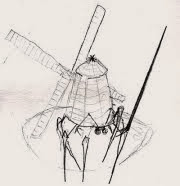
I objected, pointing out that even Abner Perry's Mechnical Mole could not have dug deep enough to lay cable to Hell.
He laughed and told me it was on a cellular network, and that there was only two mobile phone networks prefixed with 23.
One in Sierra Leone, and the other in Zimbabwe: both countrys being ravaged by hellish war and cruelty for the last thirty years.


I have become mesmerized by the Reprap and by the CandyFab. Sure, I'll admit it.
I can imagine printing things - useful things, like dino skulls and monstrously expanded ants.
I made the mistake of mentioning this to RenegadeMime, who was eating popcorn and jeering at Alvin Toffler.
He held up a popcorn kernal. "This would look good the size of a baseball." he said, "But how would you deal with the pixelization? If I wanted to look at voxels, I'd build popcorn out of Lego."
Vectors. I suggested.
"Hah." he said. And went back to reciting Future Shock in reverse, which he claims is the equivelent to time travel.
Most printers are built with stepper moters and a x-y ( and sometimes z) cartesian grids because they are conceptually simple and easy to manipulate.
But an extruder is basically a pen, with 'solid' ink. If I am drawing with a marker, I don't have pixelization problems - because I can draw real curves without staircasing.
Without the dreaded 'jaggies'.
If I used polar co-ordinates rather than cartesian, I could draw any arc - including the 'arc of infinite radius' AKA the 'straight' line.
Limits do arise; for a polar plotter, viz;
'Pen Width'...which dictates the narrowest line,
'Stroke Length'...which dictates the shortest line,
'Angular Resolution'...which dictates how similar two dis-similar lines can be,
'Integerization'...which forces all endpoints to snap to an intrinsic grid.
Noticed this interactive LED design. Seems like it would be even more interesting if it was combined with a cellular automata display. Using the input hand gestures as seeds for the cells would get ripples of patterns echoing out from your hands.
Direct interaction with the automata would be fun.
Direct interaction with the automata would be fun.
It should be possible to fit a air nozzle behind each hammer on a piano, and a valve on each key.
Pneumatic amplification - the hammer would strike with increased power; but with careful rigging of the nozzle, it should be possible to arrange it so that the hammer beats repeatedly against the strings, permitting a vibrato sustain. The valve would control the airflow, which would modify both volume and beat- rate.
If the valve box was fed from a master manifold, with a controling flow reducer, then each keys beat-rate would slow depending on how many other keys were depressed. This would give fast vibrato single notes and slow throbbing chords.
Subscribe to:
Posts (Atom)