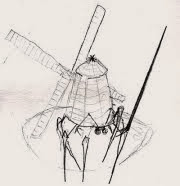
More cogitation: now the ratchets can be dispensed with. Each ratchet can be reduced to a single tooth, and that tooth placed on the end of a spring loaded arm. The neat arrangement of wheels around wheels becomes a bristly mass of hooks and spines. Should be simpler to build, and has less critical tolerences. It does however, lose the victorian steampunk look. I can probably replace the central 'heartbeat' wheel with a linear ram - which would be easier to power with steam or pneumatic power.


It is possible to create a eraseable paper tape. Its just not extremely durable.
Two tapes glued togther with internal pockets that contain paper shutters. The shutters can be slid left and right, so that the shutter can cover a hole. Its bulky - I can't imagine making it smaller then 1 cm of tape length per bit without usuing very special equipment. It also is vulnerable to data corruption, as the shutters are only locked in poistion by friction. Of course, if the tape is kept reeled, then the pressure of the tight roll will keep the shutters from shifting.
Diagram to follow.
The most basic design has to be able to avoid running into walls, and it has to be able to avoid falling over edges. Cliff detection and collision detection ; a neuralogical demand somewhere around a amoeba's.
I would also like it to keep a record on punched tape of its travels, and perhaps a odometer count.
Travel records open a new, and interesting can of worms.
Consider 'Direction of Travel'. In the simpliest form, this is left-right-forward-back. But how many 'lefts' does it take to turn a complete circle? The value is not uniform - tire slippage and real world factors act to vary the angles.
But to switch from relative reference to absolute would require a real-world frame of reference.
Bacteria and pigeons use magnetic fields. A compass would work, but would deviate badly in the electromagnetic fields that permeate our indoor enviroment.
Likewise, there are too many light sources to use a 'solar' based frame of reference. Look how badly moths do when they encounter streetlights.
A tiny gyroscope would be ideal, but I am not certain if one could be built that fits within size restraints.
Or perhaps I should say, ' size and patience' restraints - the smaller the scale, the more fiddly the manufacture.
Each cog neuron can be built with 4 possible inputs:
Fire ... which immediately triggers the neuron, unless it is in relaxation time;
Enable_Fire ... which allows the neuron to fire if a signal arrives;
Inhibit_Fire ... which prevents the neuron from firing until the signal is removed;
Inhibit_Reset ... which prevents the neuron from coming out of relaxation -
when the signal is removed, the neuron will still complete its normal relaxation time before resetting.
While Enable_Fire and Inhibit_Fire would seem to be binary choices, the neuron could have Inhibit_Fire and Enable_Fire set or unset by different neurons. A AND gate could be set up by using the Fire and the Enable_Fire inputs together. A NAND could use Fire and Inhibit_Fire together.
Its really not a question of gates though. The idea has been from the beginning to mimic neurons rather than gates, although this means I have to master networks rather then Boolean Logic.
Reading paper tape is relatively easy. I've settled on a bank of 'bump sensors' set below the tape. On every third 'heartbeat' tick, the tape is drawn forward one notch, and a set of plungers are bounced with a piano hammer style mechanism against the tape. Where their are holes, a plunger goes through, and triggers the appropiate sensor.
Writing to tape isn't much harder; the plungers have to be solidly built, and driven with a fair amount of force to punch the holes. Nothing impossible.
Now if I could get magical self-healing tape, than I could do reads and writes on the same paper.
Writing on one tape, and reading on the other is monotonous.
Even if I wrote data on the tape backwards from point X, and read program data forwards from point X, the machine will still spend a lot of time spinning tape. Not to mention the overhead in RAM for all the data pointers.
RAM...RAM...RAM...Curse'd RAM...harder to implement than vision. Curs'd, vile, wick'd inquitious RAM !
... Early scrolls could be seen as a form of paper tape, with optical readers, and a reel on each end of the scroll. Of course, the ancients never seem to have invented the cassette to protect the scrolls.
Books - a sector formatted Random Acsess Format - has proved much more useful.
'The Self Propelled Cart' by none other than the talented Leonardo da Vinci is the oldest example of a spring driven mobile mechanism that I can find. Probably was never built, and merely existed as sketches in the Atlanticus Codex.
Recently reconstructed, it should serve as a spur to the 'steampunk' alternate history buffs.
'Reconstructed'? Probably a misnomer. Recently constructed by historians, and made part of a exhibit. To me, the main question is: what was its purpose? The design is functional, blocky, looking more like the guts of a machine. Was there more to it that was never recorded?
The reconstruction is a metre long - this is a large machine. I can't find any estimates to the length of possible run, or speed, or even, for that matter, a good blueprint.
Its interesting to note the 'springs in drums' design of the power springs...practically identical to the springdrums used today.
Subscribe to:
Posts (Atom)