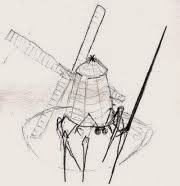
Lets digress.
I figured a small 3d printer would be a good place to experiment - after all, the print volume is expandable without significant change in the electronics or software. And smaller things - to a certain scale - are easier to build than large things.
So I picked 36 cubic inches as a arbitrary figure and started designing.
I don't like the idea of a z-axis table. What if I had, say, a T-Rex skull, and I was struck with the desire to print a doily atop it? Z-axis tables impose limits of volume and weight to the things that you want to print upon. Arguably, most printers are interested in the creation of separate parts that are later assembled into interesting objects, but I come from a device-modification background, and think the ability to append is what raises the 3d printer several notches above more traditional forms of material manipulation.
So z-axis controls the printhead height directly. Leadscrews - ala Darwin, et al. are an excellent method of lineal actuation - in use for probably two hundred years to control machine tools.
That being said, I am being seduced by the idea of hydraulic cylinders. Small, low pressure cylinders are quite easy to build and plumb.
But I'm not seduced yet, so leadscrews it is.
At first I was planning to have the y and x axes raised by a set of z-axis legs, but this meant a number of leadscrews running at once for vertical translation. There is a lovely design involoving ballchain that the Darwin uses, but I don't like having to use that many jackscrews.
So I decided to have the z-axis raise the printhead itself, and started cutting out parts on that theory.
While tinkering together a mockup this week, I realized that structurally it makes more sence to have the z-axis raise the y-axis.
This allows an 'overhanging beam' style of printer, which gives a lot more access to the area underneath the printhead.
Essentially a bastard combination of a hammerhead and a kangaroo crane. With the ability to translate along the x-axis, although as I've pointed out before, polar coordinates could be used with a rotation along the x-axis.
At first glance, this looks unstable, but seeing as the printhead mass is known, its really a simple job to adequately counterweight and brace this arm.
A 3d printer is a machine tool, and as when constructing all machine tools, solidness and rigidity need to be our watchwords. Luckily, the framework nesscary to control a kilogram printhead to accurate placement of a tenth of a millimeter is a lot easier than controlling a cutterhead with forces of hundreds of pounds and accuracy of a hundreth of a millimeter or better.
'kangahead crane?'